

 CALL THE LOCATION NEAREST YOU
How Long Does Wisdom Teeth Removal Take? Procedure Length by Case
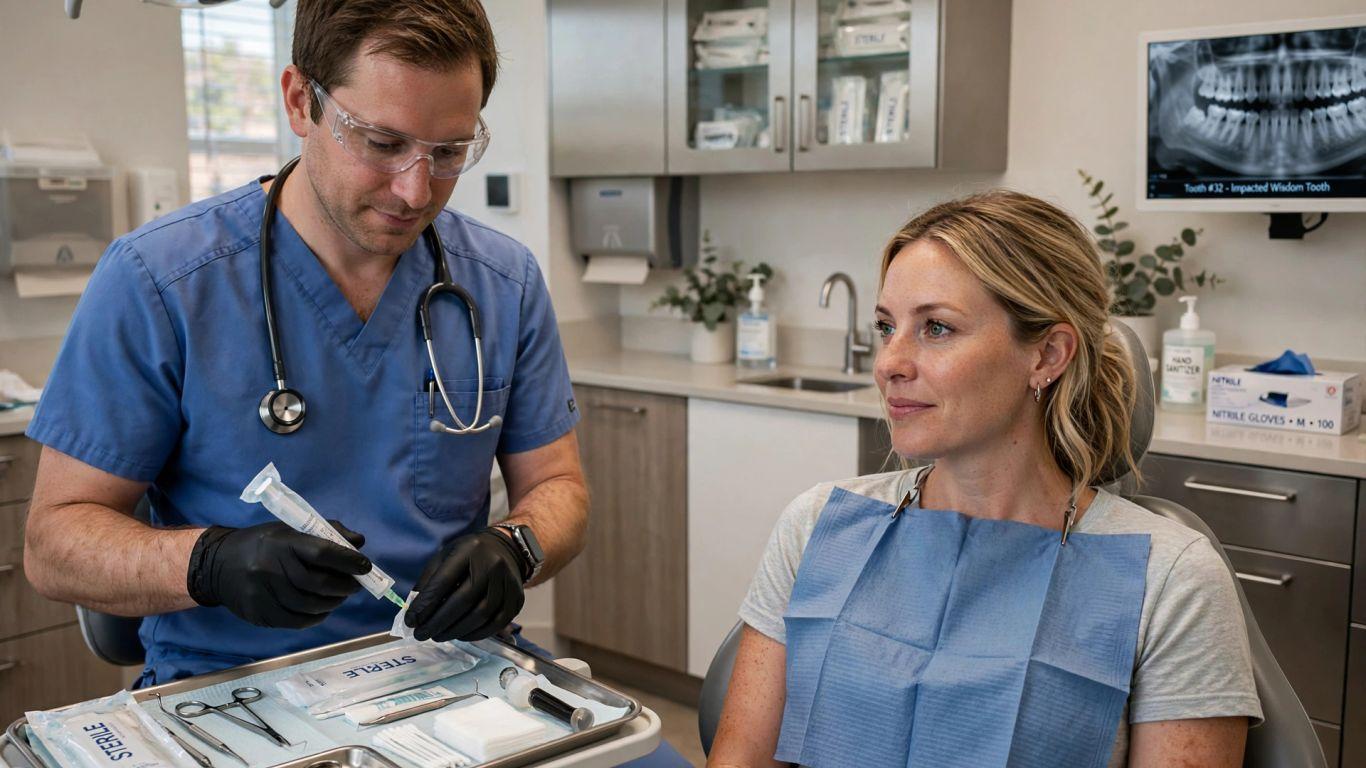
There isn’t one standard answer to how long wisdom teeth removal takes: the number of teeth, how they sit in the jaw, and the planned anesthesia all matter. The estimates below describe the extraction itself, not the full visit. They are useful for rough planning, but your oral surgeon can give a better estimate after examining your teeth and imaging.
Typical procedure time by case
One fully erupted wisdom tooth
A single wisdom tooth that has come through the gum and is easy to reach may take roughly 20 to 40 minutes to remove. The clinician still needs to numb the area, check that it is comfortable, and manage the socket afterward. A tooth that looks straightforward can take longer if access is awkward or the roots are unusual.
Several erupted teeth removed in one visit
Removing several erupted teeth in one appointment often takes longer than removing one, but the total is not always a simple multiple of the single-tooth estimate. These broad ranges refer to extraction time only:
| Case | Approximate extraction time | What may affect the estimate |
|---|---|---|
| One erupted tooth | 20–40 minutes | Access and root shape |
| Several erupted teeth | 30–60 minutes | Number of teeth and sequence |
| Impacted or partially erupted teeth | 30–90 minutes or more | Position, depth, and surgical access |
These are planning ranges, not promises. If several teeth are being removed, ask whether the quoted time includes only the extractions or also anesthesia and recovery monitoring.
Impacted or partially erupted wisdom teeth
An impacted tooth may be partly or fully beneath the gum, so the clinician may need to make an incision or remove a small amount of bone to reach it. That can make the procedure longer than a simple extraction. Learn more about our wisdom teeth services.
How the extraction procedure unfolds
The appointment usually has several stages, and the extraction is just one of them. Knowing the sequence can help explain why the visit lasts longer than the time quoted for the procedure alone.
Numbing or sedation before the extraction
The clinician will use a form of anesthesia suited to the procedure and your health history. With local anesthetic, the area is numbed while you remain awake; sedation or general anesthesia may be part of the plan for some patients. See the ADA’s overview of anesthesia and sedation.
Removing the tooth and managing the site
The clinician loosens and removes the tooth. A tooth that is difficult to reach may be divided into smaller pieces or require a surgical approach. The team then cleans the area and manages the socket.
Closing the area and checking for bleeding
Some extraction sites are closed with stitches, while others may not need them. The clinician places gauze and checks that bleeding is controlled before giving you home-care instructions.
Factors that can make surgery take longer
A tooth’s appearance above the gum does not tell the whole story. Its angle, roots, and relationship to nearby structures can affect how easily the clinician can reach and remove it.
The tooth’s position and depth of impaction
A tooth close to the surface may be easier to access than one that is tilted, trapped beneath the gum, or embedded in the jawbone. Imaging and an examination help the team anticipate those needs.
Root shape and nearby nerves or sinuses
Roots can vary in shape and direction, and upper and lower wisdom teeth sit near different anatomical structures. If a tooth’s roots are curved or close to a nerve or sinus, careful technique may take additional time.
The number of teeth and complexity of each extraction
A group of straightforward extractions may take less time than a smaller number of difficult ones. One challenging tooth can affect the schedule more than an additional easy-to-reach tooth.
Procedure time versus total appointment time
Check-in, preparation, anesthesia, and observation can all add time beyond the actual removal. The practice can clarify which parts are included in its estimate, so you can plan transportation and the rest of your day.
Check-in, imaging, and pre-procedure preparation
The visit may begin with a review of your medical history, a discussion of the plan, and imaging if needed. Review our pre-operative instructions before your appointment.
Time spent waiting for anesthesia to take effect
Local anesthetic needs time to numb the area before the extraction begins. If sedation is planned, preparation and monitoring can add time as well.
Post-procedure observation before going home
After the extraction, the team may monitor you while you become more alert. If you have sedation, ask ahead whether you will need someone to take you home.
How to get a more accurate time estimate
A useful estimate comes from the details of your particular case, not just the number of teeth on the treatment plan.
What the dentist or oral surgeon can assess on X-rays
X-rays can help the clinician assess a tooth’s position, depth, root shape, and proximity to nearby structures. Imaging supports planning, but it cannot guarantee an exact procedure time.
Details to share about your health and medications
Tell the care team about health conditions, allergies, medications, and prior experiences with anesthesia.
Questions to ask when scheduling the procedure
- How long do you expect the extraction itself to take?
- How much time should I reserve for the full appointment?
- Will my anesthesia plan change the time I need to be at the office?
- Should someone accompany me or drive me home?
If the office gives a range, ask which parts of the visit it includes. Our frequently asked questions page may also help.
Conclusion
Wisdom teeth removal may take under an hour for a straightforward case or longer when teeth are impacted or difficult to reach. The full appointment includes preparation and, when needed, observation after the extraction. To plan your procedure, contact our office and ask for an estimate based on your imaging and anesthesia plan.
Frequently Asked Questions
How long does wisdom teeth removal usually take?
The extraction itself may take roughly 20 to 90 minutes or more, depending on the number of teeth and how difficult they are to reach. Your clinician can estimate your case after reviewing your teeth and imaging.
Does removing all four wisdom teeth take longer?
It often takes longer than removing one tooth, but the total depends on how each tooth is positioned and whether the extractions are straightforward. The number of teeth alone does not determine the time.
Is an impacted wisdom tooth slower to remove?
It can be, because the clinician may need to create access through gum tissue or bone before removing it. The depth and angle of the tooth affect how much additional work is needed.
How long will I be at the office?
The total visit is longer than the extraction itself because it can include check-in, preparation, anesthesia, and observation before you leave. Ask the office how much time to reserve for your specific appointment.
Does sedation make the appointment longer?
Sedation may add time for preparation and monitoring, though the exact schedule depends on the type used and the practice’s process. Ask the care team what to expect before and after the procedure.
Can X-rays predict the exact procedure time?
X-rays help the clinician assess tooth position, roots, and nearby structures, which supports a more informed estimate. They cannot predict the exact time with certainty because each procedure can unfold differently.
What should I ask before scheduling?
Ask how long the extraction is expected to take, how much time to reserve for the appointment, and whether your anesthesia plan affects transportation or preparation. You can also ask whether anything on your imaging may make the procedure more complex.
About the Author
This article was prepared for Oral Surgeons, P.C., serving Central Iowa from offices in Des Moines, Ankeny, and Clive, and reflects the experience of our board certified oral and maxillofacial surgeons: Jeffery Schwarzkopf, DDS; Scott Johnson, DDS, MD; John Janulewicz, DDS, MD; Ryan Marsh, DDS; Luke Freml, DDS; Michael Morio, DDS; Brock Radich, DDS; Stephen Ridenour, DDS; and Michelle Peters, DDS. The practice is a proud member of the American Association of Oral and Maxillofacial Surgeons, the American Board of Oral and Maxillofacial Surgery community, and the American Dental Association.
Disclaimer
This content is for general educational purposes only and is not a substitute for professional dental or medical advice. Time estimates are broad ranges, not guarantees. Consult a qualified professional about your specific situation.
Blog Post Author

Contributed by DentalROI
DentalROI provides relevant dental content to help providers educate patients. The statements, services, and products referenced in this article have not been evaluated by the Food and Drug Administration, and they are not intended as a substitute for professional medical advice, diagnosis, or treatment. Always seek the advice of your dental provider with any questions or issues you may have. Specific recommendations may vary in different circumstances, so individual consultation is important.